Concrete Aggregate
River sand, crushed sand
Washing may reduce clay fines that weaken concrete. Compliance with any BS, ASTM, or project aggregate limit requires representative sampling and laboratory testing.
Sand Washing
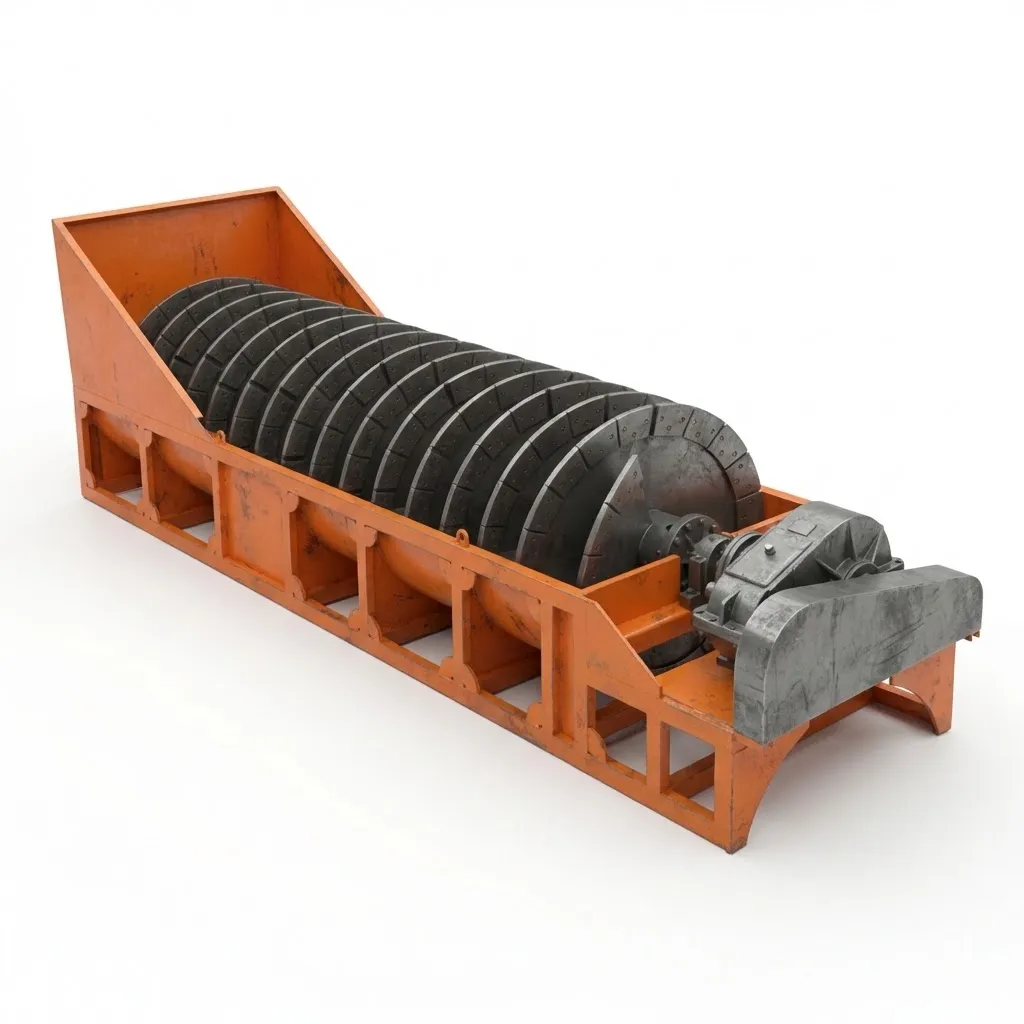
A simple, robust wheel-bucket washer that removes clay, silt, and fine impurities from sand and gravel, with controlled fine-sand loss through its mesh-screen design. Low power and low maintenance.
Pricing
We quote per project rather than publishing a single figure, because the same machine name covers models an order of magnitude apart in price. Send your duty and you get a real number back, not a brochure.
Wheel or screw size and capacity
Wheel diameter and tank width set the washing capacity, and that is the single largest factor in the price.
Water and recycling scope
Whether the quote covers only the washer or also the settling, thickening and water-recycling arrangement changes the total substantially.
Liner and blade wear parts
Abrasive feed wears blades and liners quickly. The alloy chosen here decides how often you buy replacements.
Incoterm and destination port
FOB, CIF and CFR to your port are different numbers, and a washer ships as bulky, not dense, freight.
Send the material, your required t/h and the destination port. That is enough for a quote — you do not need a full specification first.
Get Price on WhatsAppTypical reply within 12 hours · English and Chinese
The wheel-bucket design combines water-bath scrubbing and centrifugal drainage — removing clay efficiently while retaining fine sand that screw-type washers often lose.
01
Sand and gravel enter the water-filled wash tank from the feed chute. Water level is maintained by continuous supply and overflow weir.
02
The motor-driven impeller slowly rotates (1–2 RPM), rolling material in the water bath. Particle-on-particle attrition breaks up clay coatings and aggregate clusters.
03
Clean, heavy sand particles sink and are scooped by the impeller buckets. Fine clay and silt remain in suspension and exit via the overflow weir.
04
Scooped sand passes over the mesh screen arc, where surface water drains back. Clean, partially-drained sand exits the discharge chute.
| Feature | XS Wheel Bucket | Spiral Washer |
|---|---|---|
| Working Principle | Impeller rotation + water bath + mesh screen | Rotating spiral + inclined trough + water flow |
| Sand Recovery Rate | Mesh is intended to retain fine sand; confirm with feed testing | Fine loss depends on feed grading and overflow control |
| Water Consumption | Low — closed-loop recirculation possible | Moderate |
| Maintenance | Simple — fewer moving parts | Easy — spiral is robust |
| Footprint | Compact — vertical wheel | Longer — inclined trough |
| Typical Application | Fine sand (0–5 mm), aggregate plants | Coarse sand & gravel, river sand |
4 standard models. Single-wheel configuration. All accept maximum feed of 10 mm.
| Model | Wheel Diameter | Capacity | Motor Power | Water Consumption | Weight | Get Quote |
|---|---|---|---|---|---|---|
| XS-750 | 750 mm | 15–25 t/h | 2.2 kW | ~0.5 m³/t | 0.78 t | Quote |
| XS-1500 | 1500 mm | 30–60 t/h | 5.5 kW | ~0.8 m³/t | 3.5 t | Quote |
| XS-2300 | 2300 mm | 50–100 t/h | 7.5 kW | ~1.2 m³/t | 5.5 t | Quote |
| XS-2900 | 2900 mm | 60–120 t/h | 11 kW | ~1.5 m³/t | 7.8 t | Quote |
* Published capacities are reference values. Sticky or high-clay feed can materially reduce practical throughput; quantify the effect with representative feed testing, solids loading, and the proposed water balance. Published maximum feed size is 10 mm for these models.
Used wherever clean, specification-grade sand and gravel are required.
River sand, crushed sand
Washing may reduce clay fines that weaken concrete. Compliance with any BS, ASTM, or project aggregate limit requires representative sampling and laboratory testing.
Crushed limestone, granite chip
Clean aggregate free of PI fines required for asphalt mixes and base course material.
Quartz sand
Multiple-pass washing may remove surface coatings and clay films, but final SiO₂ grade and impurity limits require mineralogy and product assay confirmation.
Iron ore fines
Pre-washes ore before wet magnetic separation to remove clay that blinds magnetic drum surfaces.
Fine coal, middlings
De-sliming of fine coal before froth flotation or dense medium circuit.
Manufactured sand (VSI output)
Removes stone powder (stone dust) from VSI crusher output to meet construction sand specs.
Six components — understanding each helps you troubleshoot washing quality and sand loss.
The rotating impeller blades agitate material in the wash tank and carry clean sand upward for drainage. Blade pitch determines residence time and washing intensity.
Water-filled tank where sand is submerged and scrubbed. Overflow weir continuously removes suspended clay and silt while clean sand sinks to the impeller.
Perforated screen at the top of the impeller arc retains fine sand while allowing water to drain back into the tank. Mesh size selection is critical for minimising fine sand loss.
The low-speed (1–2 RPM) impeller is driven through a heavy-duty gear reducer. Low speed prevents sand from being flung over the screen by centrifugal force.
Clean water is continuously added while cloudy overflow water carries away clay. A settling pond or hydrocyclone can recirculate overflow water to reduce consumption.
Washed, drained sand slides down the chute after reaching the screen arc. Discharge angle and chute length can be adjusted to suit downstream conveyor layout.
Four factors determine the right XS model and configuration for your sand washing circuit.
Step 01
The XS wheel washer handles material up to 10 mm. For coarser gravel (10–50 mm) a spiral washer is more appropriate. Confirm P80 feed size before selection.
Step 02
Four published models range from XS-750 (15–25 t/h) to XS-2900 (60–120 t/h). Do not apply a fixed capacity margin: size from dry-solids feed, added water, clay and fines loading, feed variability, target availability, and the drainage duty of the selected screen.
Step 03
High-clay feed may require pre-soaking, attrition, or multiple washing stages. Do not assume a single pass will meet specification; verify the circuit with feed testing and product samples.
Step 04
The published model table lists approximate water demand from 0.5 to 1.5 m³/t. Develop a site water balance for the actual feed and evaluate settling, classification, and recirculation before sizing pumps or ponds.
Not sure which model?
Tell us your feed material type, clay content, required output t/h, and available water supply. We'll recommend the right model and water management system.
Mesh screens and impeller blades are the highest wear items. Regular checks keep washing quality consistent.
Operating checks
Planned inspection
Condition-based service
FAQ
Short answers to common procurement questions before requesting quotation.
Need deeper context?
Water demand and fine-sand loss depend on feed grading, clay content, overflow control, and the recovery circuit. Use measured samples and a site water balance before setting recycle, yield, or product claims.
Site balance
Water Recycle
Recycle potential depends on fines loading, water quality, settling area, classification equipment, and evaporation.
Feed test
Fine-Sand Loss
Measure the feed grading and overflow solids for the proposed washer; do not assume a fixed loss for wheel or spiral designs.
Circuit-specific
Fine-Sand Cut
A hydrocyclone and dewatering screen may recover additional fines, but the cut size and product yield require testwork.
Weekly trend
Operating Control
Track fresh water per tonne, return-water turbidity, overflow solids, and final-product cleanliness together; one metric alone hides the trade-off.
Submit the product specification, raw-feed grading, clay test, water supply, and target tonnage so the washer duty and water-balance assumptions can be documented in the technical proposal.
Document Plant InputsA washer is one stage in the sand-making process. Treat the equipment below as a sequence; stage capacity, product grading, and water integration require a documented plant balance.
Project brief
Share four operating inputs so we can rule out unsuitable models early and explain the assumptions behind the shortlist.