Primary Crushing
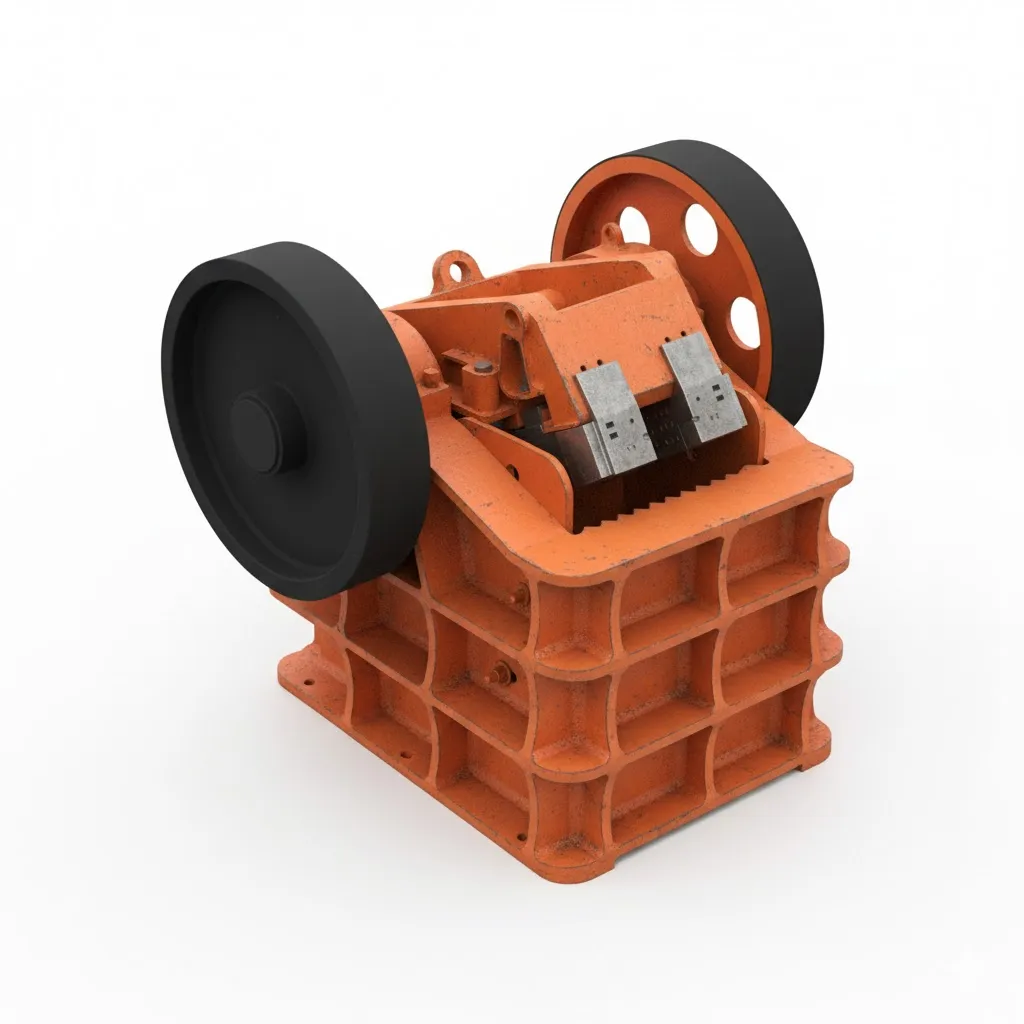
PE Series Jaw Crusher
PE and PEX jaw crushers for primary, secondary, and fine crushing duties. Twelve published models span 5 to 800 t/h; practical selection still depends on feed grading, material behavior, CSS, and operating hours.
- Published Models
- 12
- Max Capacity
- 800 t/h
- Max Feed
- 1,020 mm
Pricing
How much does it cost?
We quote per project rather than publishing a single figure, because the same machine name covers models an order of magnitude apart in price. Send your duty and you get a real number back, not a brochure.
What moves the number
Model size and capacity
The span from the smallest to the largest model in a family is usually more than tenfold. Your required t/h sets the model, and the model sets most of the price.
Manganese grade of the wear parts
Jaw plates, mantles, concaves and blow bars come in different manganese grades. A higher grade costs more up front and changes your cost per tonne over the wear life.
Motor and electrical package
A domestic motor and a Siemens or ABB package are materially different line items, as are the starter and control cabinet.
Incoterm and destination port
FOB, CIF and CFR to your port are different numbers, and ocean freight on a single crusher is not a rounding error.
Get a figure for your duty
Send the material, your required t/h and the destination port. That is enough for a quote — you do not need a full specification first.
Get Price on WhatsAppTypical reply within 12 hours · English and Chinese
How a Jaw Crusher Works
A jaw crusher breaks rock by compressive force between two jaw plates. The eccentric shaft drives a reciprocating swing jaw that crushes material against a fixed jaw, releasing it downward through the adjustable discharge gap.
01
Feed
Raw rock or ore is top-fed into the V-shaped chamber. Published maximum feed is the governing limit; opening-to-lump ratios are only preliminary checks and must be confirmed against representative block shape.
02
Compress
The eccentric shaft rotates, driving the swing jaw forward. Rock is trapped and crushed by compressive force against the fixed jaw plate.
03
Release
On the return stroke the swing jaw opens. Crushed material drops under gravity toward the narrower discharge end of the chamber.
04
Discharge
Product exits through the CSS (Closed Side Setting). A wider or narrower setting changes capacity and gradation, but final top size still depends on feed, chamber condition, and downstream screening.
PE Series — Complete Specifications
Eight published models span smaller duties through larger primary-crushing applications. Adjustment method and available CSS must be confirmed for the ordered configuration.
| Model | Feed Opening | Max Feed Size | CSS Range | Capacity | Motor Power | Weight | Get Quote |
|---|---|---|---|---|---|---|---|
| PE-250×400 | 250×400 mm | 210 mm | 20–60 mm | 5–20 t/h | 15 kW | 2.8 t | Quote |
| PE-400×600 | 400×600 mm | 340 mm | 40–100 mm | 15–60 t/h | 30 kW | 7 t | Quote |
| PE-500×750 | 500×750 mm | 425 mm | 50–100 mm | 40–110 t/h | 55 kW | 12 t | Quote |
| PE-600×900 | 600×900 mm | 500 mm | 65–180 mm | 60–180 t/h | 55–75 kW | 16.5 t | Quote |
| PE-750×1060 | 750×1060 mm | 630 mm | 80–140 mm | 80–320 t/h | 90–110 kW | 28 t | Quote |
| PE-800×1060 | 800×1060 mm | 680 mm | 80–140 mm | 110–320 t/h | 90–110 kW | 29 t | Quote |
| PE-900×1200 | 900×1200 mm | 750 mm | 95–225 mm | 140–450 t/h | 110–132 kW | 52 t | Quote |
| PE-1200×1500 | 1200×1500 mm | 1020 mm | 150–350 mm | 400–800 t/h | 160–220 kW | 100.9 t | Quote |
* CSS = Closed Side Setting. Published capacity is an initial comparison range, not a guaranteed site result. Confirm material strength, abrasiveness, feed grading, moisture, CSS, and operating hours with testwork or representative samples.
Main Components
Understanding each component helps you order the right spares and perform targeted maintenance. All wear parts availability and dispatch timing must be confirmed by part number and quantity.
Frame
Heavy-duty welded or cast-steel frame. The fixed jaw plate is bolted directly to the front wall, forming one half of the crushing chamber.
Eccentric Shaft
Forged alloy-steel shaft transmits rotary motion from the motor to create the swing jaw's reciprocating movement, mounted in spherical roller bearings.
Movable (Swing) Jaw
Suspended from the eccentric shaft at the top. Moves in an elliptical arc — wider at the feed end, narrower at discharge — maximising nip angle and throughput.
Fixed Jaw
Stationary jaw plate bolted to the front frame. Works in tandem with the movable jaw to generate compressive crushing force against the rock.
Jaw Plates
High-manganese steel (Mn13–Mn18) with a corrugated profile to grip material. The reversible design allows the opposite face to be used; actual wear life depends on feed abrasiveness and operating conditions.
Toggle Plate
Transmits thrust to the swing jaw on the power stroke. Some designs also use the toggle as part of the overload-protection strategy; the failure mode and replacement specification must be confirmed for the ordered machine.
Tension Spring & Rod
Pulls the swing jaw back on the return stroke and helps keep the toggle plate seated. Correct preload can limit return-stroke movement; the setting must follow the ordered machine manual.
Flywheel
Twin flywheels store kinetic energy to smooth the crushing cycle and moderate peak motor demand. The actual load profile depends on feed presentation, chamber condition, and drive configuration.
Industry Applications
PE jaw crushers handle compressive strength up to 320 MPa — suitable for virtually all hard, medium-hard, and brittle materials.
Mining
Gold ore, copper ore, iron ore, manganese ore
Pre-crushes ROM ore to belt-conveyor feed size before secondary grinding mills.
Quarrying
Granite, basalt, andesite, diorite
Often considered for competent rock in a primary stage; suitability must be checked against material strength, abrasiveness, block shape, and the selected model's documented feed limit.
Limestone & Cement
Limestone, dolomite, calcite
Medium-hard feed for cement raw material or downstream ball mills and kilns.
Construction Recycling
Demolished concrete, brick rubble, asphalt
Breaks down demolition waste to recyclable aggregate for road base.
Metallurgy
Slag, laterite nickel ore, chrome ore
Handles abrasive, irregular lump material with fast wedge-type CSS adjustment.
Road Construction
River pebble, sandstone, mixed aggregate
Produces road base and sub-base aggregate at an adjustable discharge size.
How to Select Your PE Model
Follow these four steps to narrow the model range. Final selection should be confirmed against the documented operating conditions.
01
Determine Maximum Feed Size
Measure the largest lump dimension and record block shape as well as nominal top size. An opening-to-lump ratio can support an initial shortlist, but the selected model must be checked against its published maximum feed and representative material before purchase.
02
Define Required Throughput
Set the required t/h and operating schedule, then allow a documented margin for feed variability, liner wear, and planned expansion. Do not apply one fixed percentage without checking testwork, upstream feeding, and the duty cycle.
03
Check CSS Range vs. Required Output Size
CSS (Closed Side Setting) influences the product-size distribution and capacity, but does not by itself guarantee a top size. Confirm the available CSS range against feed grading, recirculation, and the downstream screen target.
04
PE vs. PEX — Which Series?
PE is generally shortlisted for primary duty; PEX is generally evaluated for smaller-feed secondary or fine duty. Whether PEX can replace another crushing stage depends on material tests, required product shape, and the published limits of the selected model.
Not sure which model fits?
Submit the raw material, maximum lump size, required t/h, and target output size so the selected model can be checked against those operating conditions.
Maintenance Schedule
Inspection and lubrication can reduce avoidable wear and unplanned failures, but service intervals and component life depend on feed abrasiveness, duty cycle, environment, and the ordered machine manual.
Each Shift / Per Manual
- Lubricate each bearing using the ordered machine's grease type and quantity
- Check V-belt tension against the installed drive specification
- Inspect jaw plate ridges for cracks or heavy wear
- Verify discharge chute is clear of build-up
Routine Planned Check
- Measure CSS using the supplier-approved method; adjust only within the documented range
- Check toggle plate seating and tension spring pre-load
- Inspect flywheel key and eccentric shaft end nuts for looseness
- Record empty-run motor amperage (rising amps = wear indicator)
Condition-Based Service
- Rotate or replace jaw plates at the documented wear limit and after checking chamber profile
- Renew bearing lubricant at the interval stated for the installed bearing and operating environment
- Inspect toggle plate for cracks; replace as matched pair
- Check frame welds and liner bolts for fatigue or looseness
PE Series Feature Checklist
Wedge-type CSS (Closed Side Setting) adjustment across the listed discharge ranges
Deep V-shaped chamber geometry for continuous compression; actual throughput depends on feed and CSS
Dual-flywheel eccentric shaft for smooth, balanced operation
Replaceable, reversible high-manganese jaw plates
Spring overload mechanism intended to limit damage from uncrushable tramp material
Accessible jaw-plate layout for inspection and replacement
Jaw Crusher Wear Parts & Spares We Supply
PE / PEX consumable and structural spare availability, drawing revision, geometry, manganese grade, pricing, and dispatch timing must be confirmed for the ordered model and quantity.
Swing jaw plate (Mn13Cr2 / Mn18Cr2)
Movable jaw face and primary wear item. Replacement timing must be based on measured profile loss, feed abrasiveness, chamber performance, and the wear limit documented for the ordered plate.
Fixed jaw plate
Stationary side liner. Rotation or paired replacement may help preserve chamber geometry, but the maintenance decision must follow measured wear and the supplier's plate-matching guidance.
Tension rod & spring assembly
Pulls the toggle plate against the swing jaw and carries return-stroke load. Treat it as a critical inspected spare; the recommended opening stock depends on the installed design and local lead time.
Toggle plate
Transmits crushing thrust and may form part of the overload-protection design. Confirm material, intended failure behavior, model compatibility, and included fasteners in the written spare-parts scope.
Eccentric shaft & bearings
Shaft and bearing replacement is a major maintenance event. Confirm shaft material, bearing references, fit tolerances, and whether a matched kit is included before ordering.
Thrust plate seat & bushings
Seat and bushings carry toggle thrust and should be assessed against the supplier's wear criteria. Confirm bushing inclusion and dimensions in the quoted spare-parts scope.
FAQ
PE / PEX Jaw Crusher FAQ
Short answers to common procurement questions before requesting quotation.
- How do I choose the right PE jaw crusher model?
- Start with maximum feed size, then confirm throughput, target output, and CSS range. Calculate any capacity margin from feed variation, duty cycle, recirculating load, wear condition, and expansion plans.
- What is the difference between PE and PEX jaw crushers?
- PE models are primary crushers with larger feed openings. PEX models are fine-jaw units for smaller feed and tighter discharge in secondary or fine duty.
- Can PE jaw crushers process granite and hard rock?
- Yes. PE jaw crushers are designed for hard and abrasive materials up to about 320 MPa compressive strength, including granite, basalt, and various ores.
- What maintenance is most important on a jaw crusher?
- Prioritize lubrication, CSS checks, and jaw plate wear monitoring. Consistent preventive maintenance reduces unplanned shutdowns and protects the shaft and frame.
- How should payment terms be verified?
- Payment method, deposit schedule, currency, beneficiary, and release documents must be stated in a supplier-issued proforma invoice or sales contract. Do not transfer funds based only on website copy; independently verify the beneficiary and document version before payment.
- How should shipping terms be confirmed?
- Available destinations and Incoterms depend on the quoted equipment and route. The quotation should name the port, Incoterms version, freight scope, packing method, export-document responsibility, insurance, and any exclusions; destination duties and local permits also need separate confirmation.
- What installation and commissioning scope should I confirm?
- Ask the quotation to state which drawings, manuals, remote support, site supervision, commissioning tests, and acceptance records are included. If on-site work is offered, the contract should also allocate travel, visa, accommodation, safety, tooling, and schedule responsibilities.
- How should I plan spare and wear parts?
- Request a wear-parts list with part numbers, material grades, recommended opening stock, quoted availability, and replacement lead time. Parts availability and interchangeability are not confirmed until they appear in the written supply scope.
- What must the warranty document cover?
- The warranty period, start date, covered components, exclusions, evidence required for a claim, and available remedy must be stated in the signed contract. Website information is not a warranty certificate; pay particular attention to wear parts and site-condition exclusions.
Need deeper context?
Complete Your Crushing Line
Fine Jaw Crusher Specifications
PEX models are evaluated for pre-crushed secondary or fine duties. Whether they can replace another crushing stage depends on feed behavior, required gradation, product shape, and the selected model limits.
| Model | Feed Opening | Max Feed Size | CSS Range | Capacity | Motor Power | Weight | Get Quote |
|---|---|---|---|---|---|---|---|
| PEX-250×750 | 250×750 mm | 210 mm | 25–60 mm | 12–35 t/h | 22 kW | 4.9 t | Quote |
| PEX-250×1000 | 250×1000 mm | 210 mm | 25–60 mm | 16–52 t/h | 30–37 kW | 6.5 t | Quote |
| PEX-250×1200 | 250×1200 mm | 210 mm | 25–60 mm | 20–60 t/h | 37 kW | 7.7 t | Quote |
| PEX-300×1300 | 300×1300 mm | 250 mm | 20–90 mm | 16–105 t/h | 75 kW | 11 t | Quote |
* Treat PEX as a pre-crushed-feed shortlist. Confirm maximum feed, strength, abrasiveness, moisture, and required product distribution against the ordered model and representative samples.
Project brief
Start with the operating duty, then narrow the equipment path.
Share four operating inputs so we can rule out unsuitable models early and explain the assumptions behind the shortlist.