Secondary / Fine Crushing
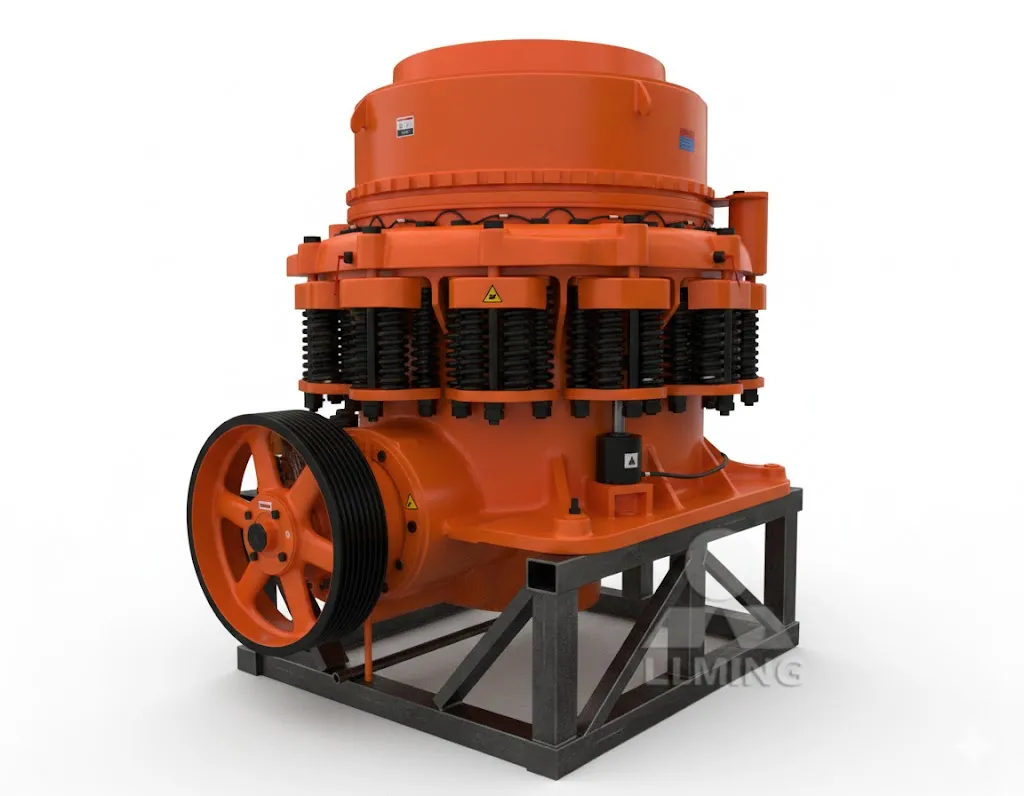
PY Spring Cone Crusher
Thirteen published PYB, PYZ, and PYD configurations cover secondary and fine-crushing comparison ranges from 12 to 640 t/h. Final chamber and model selection requires feed grading, material behavior, target product, and circuit confirmation.
- Published Models
- 13
- Chamber Types
- 3
- Max Capacity
- 640 t/h
- Typical shortlist for granite, basalt, iron ore, and other abrasive feed after primary crushing
- Compare PYB, PYZ, and PYD chamber ranges against feed grading and target product distribution
- Published capacities are comparison ranges that require material and circuit confirmation
Comparison boundary: Spring cone crushing is often shortlisted for abrasive hard rock, while PF impact crushing may merit comparison for lower-abrasion feed when particle shape is the leading objective. Confirm the choice with representative wear and gradation data.
Pricing
How much does it cost?
We quote per project rather than publishing a single figure, because the same machine name covers models an order of magnitude apart in price. Send your duty and you get a real number back, not a brochure.
What moves the number
Model size and capacity
The span from the smallest to the largest model in a family is usually more than tenfold. Your required t/h sets the model, and the model sets most of the price.
Manganese grade of the wear parts
Jaw plates, mantles, concaves and blow bars come in different manganese grades. A higher grade costs more up front and changes your cost per tonne over the wear life.
Motor and electrical package
A domestic motor and a Siemens or ABB package are materially different line items, as are the starter and control cabinet.
Incoterm and destination port
FOB, CIF and CFR to your port are different numbers, and ocean freight on a single crusher is not a rounding error.
Get a figure for your duty
Send the material, your required t/h and the destination port. That is enough for a quote — you do not need a full specification first.
Get Price on WhatsAppTypical reply within 12 hours · English and Chinese
How a Spring Cone Crusher Works
The cone crusher uses an eccentric gyratory motion to continuously squeeze material between a rotating mantle and a stationary bowl liner. Reduction ratio, capacity, and product shape vary with chamber, CSS, feed grading, liner condition, and circuit arrangement.
01
Feed
Pre-crushed material (typically from a jaw crusher) is top-fed into the crushing chamber. Feed size must not exceed the model's rated maximum.
02
Gyrate
The eccentric bushing causes the mainshaft to precess in a gyratory orbit. The mantle continuously advances toward and retreats from the bowl liner around its full circumference.
03
Squeeze
Material is nipped between the mantle and bowl liner. As it falls lower in the chamber it is squeezed progressively tighter until it is smaller than the CSS.
04
Discharge
Crushed product exits through the CSS gap. Adjustment procedure depends on the supplied mechanism and safety documentation; do not assume the setting can be changed while running.
Wider, deeper chamber intended for secondary duty. Published feed and CSS ranges support comparison, while actual product distribution must be confirmed against the material and downstream screen.
Intermediate chamber profile for secondary/fine crushing. Feed ≤230 mm, CSS 5–30 mm. Bridges between PYB secondary and PYD fine crushing.
Short, tight chamber for fine/tertiary crushing. Feed ≤100 mm, CSS 3–15 mm. Produces road chip and well-shaped fine aggregate.
Standard Chamber — Secondary Crushing
5 cone sizes from PYB-600 to PYB-2200. Feed up to 300 mm, CSS 12–60 mm.
| Model | Max Feed | CSS Range | Capacity | Motor Power | Weight | Get Quote |
|---|---|---|---|---|---|---|
| PYB-600 | 75 mm | 12–25 mm | 12–25 t/h | 30 kW | 5 t | Quote |
| PYB-900 | 115 mm | 15–50 mm | 50–90 t/h | 55 kW | 11.2 t | Quote |
| PYB-1200 | 145 mm | 20–50 mm | 110–168 t/h | 110 kW | 24.7 t | Quote |
| PYB-1750 | 215 mm | 25–60 mm | 280–480 t/h | 160 kW | 50.3 t | Quote |
| PYB-2200 | 300 mm | 30–60 mm | 440–640 t/h | 280 kW | 80 t | Quote |
Medium Chamber — Secondary / Fine Crushing
Feed ≤230 mm, CSS 5–30 mm. Bridges PYB secondary and PYD fine stages.
Short-Head Chamber — Fine / Tertiary Crushing
Feed ≤100 mm, CSS 3–15 mm. Produces road chip and shaped fine aggregate down to 3 mm.
| Model | Max Feed | CSS Range | Capacity | Motor Power | Weight | Get Quote |
|---|---|---|---|---|---|---|
| PYD-900 | 35 mm | 3–13 mm | 15–50 t/h | 55 kW | 11.2 t | Quote |
| PYD-1200 | 50 mm | 3–15 mm | 18–105 t/h | 110 kW | 25.3 t | Quote |
| PYD-1750 | 90 mm | 5–15 mm | 75–230 t/h | 160 kW | 50.3 t | Quote |
| PYD-2200 | 100 mm | 5–15 mm | 120–340 t/h | 260 kW | 80 t | Quote |
* CSS = Closed Side Setting. Published capacities are comparison ranges, not guaranteed site output. Confirm feed grading, strength, abrasiveness, moisture, liner profile, CSS, and recirculating load with testwork or representative samples.
Typical Chamber and Model Shortlists
Buyers usually shortlist by stage first, not by cone diameter alone. Start with the chamber family that matches your duty, then confirm size from the tables.
12-90 t/h secondary crushing
PYB-600 / PYB-900
Small granite or basalt lines after PE-400×600 to PE-600×900 jaw crushers.
A possible starting range for smaller hard-rock secondary duties; verify gradation, wear assumptions, and installed cost before selection.
110-480 t/h mainline quarry or mining duty
PYB-1200 / PYB-1750
The commercial middle of the market for hard-rock quarries, iron ore, and copper or gold prep circuits.
These are usually the first models to compare when feed is abrasive and PF wear cost looks too high.
18-410 t/h bridge or fine crushing
PYZ / PYD chambers
Plants that already have a secondary stage and need tighter output, smaller chip, or pre-mill feed.
Choose PYZ when you still need some reduction room; choose PYD when target output is already tight.
Main Components
Eight core components — understanding each helps you maintain correctly and order the right spares.
Mainshaft & Mantle
The crushing cone (mantle) is mounted on the mainshaft. It gyrates in an eccentric motion, progressively squeezing material against the bowl liner as it precesses around the crushing chamber.
Bowl & Bowl Liner
The stationary outer crushing surface. Made from high-manganese steel. Three liner profiles — standard (PYB), medium (PYZ), short-head (PYD) — give each series its characteristic crushing chamber geometry.
Eccentric Bushing
Converts the motor's rotary input into the mainshaft's gyratory motion. Operating speed, throw, chamber profile, and feed condition jointly influence throughput and gradation; confirm the ordered model data.
Spring Safety System
A spring pack sits between the adjustment ring and frame as part of the overload-relief system. Spring quantity, release behavior, reset procedure, and tramp-metal limits must be confirmed for the ordered configuration.
Adjustment Ring
Rotating the adjustment ring raises or lowers the bowl and changes CSS (Closed Side Setting). The approved adjustment and isolation procedure depends on the supplied mechanism; do not assume on-load adjustment is permitted.
Dust Seal
The specified dust-seal arrangement helps limit fine-particle ingress into the lubrication system. Seal condition and oil cleanliness must be monitored because contamination can accelerate bearing and bushing wear.
Lubrication System
A circulating-oil system lubricates the eccentric bushing, thrust bearing, and mainshaft bearing. Alarm and shutdown thresholds are control-system settings that must be verified from the ordered electrical and lubrication documentation.
Drive Shaft & Bevel Gear
Horizontal drive shaft transmits motor power to the vertical eccentric via a pair of bevel gears. Gear mesh quality directly affects noise level and eccentric bearing life.
Industry Applications
Cone crushers are commonly evaluated for abrasive materials. Compare expected liner wear, energy, capacity, and measured product shape before choosing them over another crushing route.
Hard Rock Quarrying
Granite, basalt, trap rock
PYB is commonly evaluated after primary crushing, while PYD may be considered for a finer stage; actual product distribution requires circuit and material confirmation.
Iron Ore Beneficiation
Magnetite, hematite, limonite
Secondary crushing to liberate iron minerals before ball mill grinding.
Copper & Gold Mining
Porphyry copper, gold-bearing quartz
Multi-stage cone crushing may prepare ore for grinding, but stage feed and final top size depend on chamber choice, CSS, screening, and recirculating load.
Road Aggregate
Granite, basalt, gabbro
A PYD short-head chamber may enter the shortlist for smaller hard-rock product bands; compare measured gradation and wear economics with impact-crushing alternatives.
Abrasive Materials
Quartzite, silicon carbide ore
Cone crushing is often compared with impact crushing for abrasive feed; liner life, product shape, power, and total wear cost should be assessed from representative duty data.
Why buyers move from impact to cone
The main reason is usually wear cost per ton, not raw throughput. On abrasive granite, basalt, iron ore, or quartzite, a cone crusher usually wins once the plant runs long enough for blow-bar replacement cost to matter.
- Better fit for abrasive hard rock and long continuous shifts.
- Tight CSS control supports secondary, bridge, and fine crushing stages.
- PYB, PYZ, and PYD let you match stage duty instead of forcing one chamber to do everything.
What we need to size a PY cone
Send these inputs and we can usually narrow the choice to one chamber family and one or two cone diameters.
- Material type and abrasiveness: granite, basalt, iron ore, copper ore, quartzite, etc.
- Maximum feed size coming from the upstream jaw crusher or screen.
- Target output size or CSS range, such as 12-25 mm or 5-15 mm.
- Required throughput in t/h plus daily operating hours.
- Upstream and downstream machines so the cone can be matched to the full circuit.
How to Select Your PY Model
Start with chamber type, then match cone size to throughput. Verify the selection against the documented operating conditions.
01
Choose Chamber Type: PYB, PYZ or PYD
Use the published PYB, PYZ, and PYD feed and CSS ranges to form an initial chamber shortlist. Then check representative feed grading, abrasiveness, required product distribution, and the downstream screen before confirming the chamber.
02
Match Cone Diameter to Throughput
Compare the published cone sizes against required throughput, but do not apply a fixed capacity margin. Feed presentation, chamber profile, CSS, liner condition, moisture, and recirculating load all affect practical output.
03
Set CSS to Target Output Size
CSS influences product-size distribution and capacity, but one CSS does not guarantee a specific P80. Use material testing or comparable operating data and include the screen and recirculating load in the circuit balance.
04
Verify Feed Size Does Not Exceed Limit
Respect the published maximum feed and confirm oversize frequency and block shape. If upstream discharge can exceed the limit, evaluate pre-screening, upstream CSS changes, or another model before final selection.
Not sure which chamber type or size?
Share feed material, grading, required product bands, and t/h target so PYB, PYZ, and PYD can be shortlisted against explicit operating assumptions.
Maintenance Schedule
Oil temperature, dust seal water supply, and liner wear measurement are the three most critical checks for spring cone crusher uptime.
Each Shift / Per Manual
- Check inlet and outlet oil temperature against the supplied alarm limits
- Verify oil pressure against the ordered lubrication-system specification
- Listen for knocking or abnormal vibration — stop immediately if heard
- Inspect discharge for oversize material indicating CSS has shifted
Routine Planned Check
- Measure CSS using the supplier-approved method and isolate the machine before adjustment
- Inspect dust seal water supply — loss of water seal causes rapid oil contamination
- Check spring tension and look for cracked or broken springs
- Verify bevel gear oil level in gear housing
Condition-Based Service
- Replace mantle and bowl liner at the documented wear-profile limit
- Sample or renew lubrication oil at the interval specified for the installed system and environment
- Inspect eccentric bushing for scoring or excessive clearance
- Check mainshaft keyway and retaining nut torque
PY Series Feature Checklist
Chamber variants for coarse, medium and fine secondary crushing duties
Spring overload protection for tramp material
Bowl and liner layout designed for planned wear-part replacement
Adjustable closed-side setting; confirm the adjustment package for the quoted model
Dry-oil sealing arrangement intended to limit dust ingress
Customised & OEM Cone Crusher Variants
Beyond the standard PYB / PYZ / PYD chambers, we build PYT tertiary-fine and PYF composite-spring cone crushers in our own factory, as standard units, customised chambers or OEM-branded orders. Chamber drawings, wear-part compatibility and QC records come with the quotation.
Tertiary fine crushing
Customised PYT spring cone crusher
PYT is the tertiary fine-crushing configuration of the spring cone platform. Customised mantle profile, CSS range, and chamber shape for 3–15 mm fine product on granite, basalt, and abrasive ore. Available as customised build or full OEM order.
Composite spring
PYF composite cone crusher
Composite-spring layout built as an alternative to the standard PY series. Tell us your current PYB / PYZ / PYD unit and we state which wear parts carry over and which are PYF-specific, against the drawing for the machine you order.
OEM & private label
Customised branding & documentation
OEM nameplate, paint and documentation for resellers and integrators. MOQ, delivery schedule and customisation scope are set out in the quotation, and QC records ship with each unit.
Cone Crusher Wear Parts & Spares We Supply
PYB / PYZ / PYD wear, hydraulic, and lubrication spare availability, drawing revision, geometry, manganese grade, pricing, and dispatch timing must be confirmed for the ordered model and quantity.
Mantle (cone head)
Wearing surface on the rotating cone. Profile, manganese grade, matching bowl liner, and paired replacement guidance must be confirmed against the installed chamber and drawing revision.
Bowl liner / concave
Stationary chamber wear face. Confirm which coarse, medium, or fine profiles are documented for the installed model and whether they preserve the intended nip and CSS range.
Eccentric bushing & sleeve
Bronze or composite alloy. Drives the mantle gyration and is critical for chamber geometry. Replace during planned maintenance using the supplier's documented lifting and replacement procedure.
Spring assembly & tension rods
Part of the overload-relief system. Its response to uncrushable material depends on spring condition, setting, and machine design; inspect and service it according to measured condition and the manual.
Oil lubrication & circulation system
Pump, cooler, filter, and reservoir may be quoted as a package or as individual parts. Oil starvation or contamination can damage bushings; define monitoring and local critical-spare needs in the maintenance plan.
Hydraulic overload cylinder
Relevant only to hydraulic-equipped variants and PYF composite designs. Confirm whether a reseal kit, full cylinder, or neither is included for the exact model and revision.
FAQ
PY Spring Cone Crusher FAQ
Short answers to common procurement questions before requesting quotation.
- How do I choose between PYB, PYZ, and PYD chambers?
- PYB is for secondary duty, PYZ for medium/fine transition, and PYD for fine or tertiary duty. Chamber choice depends on feed size and required discharge.
- What is the most important factor for cone crusher selection?
- Match chamber type first, then cone diameter to throughput with margin. CSS setting should be verified against your final product specification.
- Can I adjust product size without long downtime?
- Yes. CSS can be adjusted via the adjustment system, but final calibration should always be checked under stable feed conditions.
- What failures are most common in cone operation?
- The common risk points are lubrication contamination, dust-seal issues, and delayed liner replacement. These directly affect uptime and wear cost.
- How should payment terms be verified?
- Payment method, deposit schedule, currency, beneficiary, and release documents must be stated in a supplier-issued proforma invoice or sales contract. Do not transfer funds based only on website copy; independently verify the beneficiary and document version before payment.
- How should shipping terms be confirmed?
- Available destinations and Incoterms depend on the quoted equipment and route. The quotation should name the port, Incoterms version, freight scope, packing method, export-document responsibility, insurance, and any exclusions; destination duties and local permits also need separate confirmation.
- What installation and commissioning scope should I confirm?
- Ask the quotation to state which drawings, manuals, remote support, site supervision, commissioning tests, and acceptance records are included. If on-site work is offered, the contract should also allocate travel, visa, accommodation, safety, tooling, and schedule responsibilities.
- How should I plan spare and wear parts?
- Request a wear-parts list with part numbers, material grades, recommended opening stock, quoted availability, and replacement lead time. Parts availability and interchangeability are not confirmed until they appear in the written supply scope.
- What must the warranty document cover?
- The warranty period, start date, covered components, exclusions, evidence required for a claim, and available remedy must be stated in the signed contract. Website information is not a warranty certificate; pay particular attention to wear parts and site-condition exclusions.
Need deeper context?
Complete Your Crushing Line
Project brief
Start with the operating duty, then narrow the equipment path.
Share four operating inputs so we can rule out unsuitable models early and explain the assumptions behind the shortlist.